
Automation of IMDS processes using
IMDS Plus and IMDS Generator software –
A modern approach to material data management


Introduction
For more than a decade I have been supporting automotive manufacturers and suppliers in the areas of IMDS, Product Compliance, and material data management. During this time, I have participated in hundreds of projects involving the preparation of material declarations for OEMs, implementation of IMDS processes, automation of reporting workflows, and resolution of material data quality issues.
Throughout my career, I have observed that one of the greatest challenges remains the efficient management of IMDS data. In many organizations, the preparation and maintenance of material data continue to be managed manually. This results in higher operational costs, extended project lead times and difficulties in maintaining the required level of data quality.
This is the reason why I developed IMDS Generator and the Request Center portal. Solutions designed to create harmonized, high-quality material data and support simple and efficient future updates. These systems allow fully automated MDS creation, provide an intuitive user interface, and are easy to use.
As a business partner of DXC Technology, I implement IMDS Generator in organizations using IMDS Plus (the successor to IMDS A2 Optimizer) or IMDS Connect. From the very beginning, the solution was designed to maximize the use of functionalities available within the standard and widely accessible tools offered in DXC Technology portfolio. As a result, companies can effectively automate their IMDS data preparation processes without investing in expensive compliance platforms, complex system integrations, or lengthy implementation projects that are often required by enterprise-class solutions.
Why IMDS data preparation is becoming a growing challenge?
To better understand the purpose of this solution, it is worth asking: why IMDS data preparation is becoming a growing challenge?
In recent years, the importance of material data has grown significantly. IMDS is no longer just a tool used for PPAP and OEM part approval. Today, the data collected within the system supports numerous processes, including:
- Legal requirements (ELV, REACH, TSCA, POPs, SCIP Reporting, etc.),
- Due Diligence obligations,
- Product Carbon Footprint (PCF) and Life Cycle Assessment (LCA),
- Product chemical composition analysis to identify regulated and potentially regulated substances (GADSL).
At the same time, the IMDS Steering Committee is continuously developing the system, adapting it to new regulatory and business requirements. A good example is the proposed revision of the ELV Directive (ELV-R) and the increasing requirements for recycled material content in vehicles. This requires OEMs to more closely monitor and document material composition from the early stages of the supply chain (see details in the article “Guidelines for Recycled Materials in IMDS: Part 1”).
Another significant change in the IMDS ecosystem was the decision to onboard the electronics industry (see details “IMDS Terms of Use Version 7.0 (IMDS ToU V7”). Electronic products are characterized by a much more complex structure, a large number of small components, a wide variety of materials and parts, and highly dynamic supply chains. All of this makes the process of building and maintaining reliable IMDS data more challenging.
Another example of the scale of these changes is the upcoming PFAS regulations, which require companies to assess thousands of products that have been in serial production for many years. Determining which products contain these substances is already a big challenge for many companies operating in the automotive supply chain (see details in the article „PFAS in automotive supply chain: all you need to know”).
All of this means that MDS material data must be kept continuously up to date.
The problem is not just technology
In many companies, responsibility for IMDS is distributed across quality, purchasing, engineering, and manufacturing departments around the world. Employees preparing MDS declarations often treat it as just one of many day-to-day responsibilities and may not have specialized expertise in the field. As a result, the primary objective is often to secure customer approval of the MDS and complete the PPAP process, rather than to build high-quality material data.
Global organizations often do not have a dedicated team or standardized procedures in place. As a result, the data entered into the system is often unreliable and, in some cases, incorrect. The consequences of poor IMDS data quality extend beyond compliance reporting, leading to inaccurate results in downstream analyses, including chemical composition assessments (GADSL), material consumption analyses, and EU Taxonomy assessments which have received a lot of attention recently.
IMDS does not end with PPAP approval
An MDS declaration is no longer a one-time project task. Nevertheless, in many cases, once it has been approved by the OEM customer, it stops being properly maintained, even though the product undergoes numerous changes. This is especially well understood by aftermarket teams, which often inherit such data.
In practice, manufacturers regularly introduce:
- Design changes,
- New suppliers,
- Alternative materials,
- Different levels of recycled content.
Each of these changes may affect the material compliance of the product. With a manual process, updating hundreds or thousands of MDS declarations becomes virtually impossible.
Automation makes it possible to change this approach. With IMDS Generator, the current product structure can be quickly recreated based on the BOM while automatically using the latest data available in IMDS. This makes it possible to update IMDS data on demand without manually rebuilding entire structures, or to rapidly regenerate complete product trees in IMDS from scratch.
How IMDS Generator works
The software uses data directly from ERP/PLM systems (e.g., SAP) or other BOM (Bill of Materials) sources. It analyzes the product structure, identifies available supplier and in-house material declarations, and then prepares a complete tree structure ready for import into the IMDS system (see IMDS Information Pages – Data Import – IMDS Public Pages).
The process includes, among others:
- BOM data import,
- Automated mapping of MDS data based on current suppliers,
- Reuse of existing MDS and creation of new ones based on available materials and semi-components,
- Weight control and calculation,
- Identification of missing data,
- Supplier communication.
Once the process is completed, the user receives a ready-to-import file that can be used in IMDS Plus / IMDS A2 Optimizer or IMDS Connect. As a result, the MDS structure is built automatically and remains aligned with the actual product structure.
Integration with IMDS
IMDS Generator produces data fully compliant with current IMDS requirements, including:
- Product tree structure,
- Weight and percentage data,
- Recycled content information,
- Polymer marking,
- Application attributes.
After importing the file, the MDS structure is created automatically, eliminating the need for manual reconstruction of the tree in IMDS.
Issue identification – Error Collector
One of the key challenges in IMDS declarations is identifying missing and the most up-to-date data within the supply chain. That is why I developed the Error Collector feature in IMDS Generator, which enables:
- Identification of missing MDS declarations,
- Monitoring supplier data quality,
- Preparation of corrective actions and related communication
- Quick project status reporting to all stakeholders.
Reducing the time required for issue identification, analysis, and communication improves overall process efficiency.
Request Center – structured request management process
Request Center is a platform for managing IMDS, CAMDS requests as well as required Product Carbon Footprint (PCF) calculations. It standardizes the request submission process and ensures efficient communication and full actions traceability.
Synergy: Request Center + IMDS Generator + IMDS Plus
Once a request is created in Request Center, the data can be automatically processed by IMDS Generator and then imported into IMDS Plus. This creates a complete, digital, repeatable, and precise end-to-end process.
Business benefits
In many organizations, the main challenge is not the lack of material data, but rather its quality, timeliness, and the ability to effectively manage it throughout the entire product lifecycle.
Low-quality data leads to inaccurate analyses, which may result in additional costs, project delays, regulatory compliance issues, and even challenges related to the availability of materials and components.
Implementing IMDS Generator not only significantly reduces the time required to prepare MDS declarations, but also improves material data quality and increases the efficiency of multiple business processes.
Key benefits include:
- Reduction of IMDS preparation time by up to 80–90%, thanks to automated use of BOM data and existing material declarations,
- Lower operational costs by reducing manual work, the number of errors, and time spent on corrections and communication,
- Improved material data quality, resulting in lower number of OEM rejections and more reliable, data-driven analyses,
- Easier maintenance of up-to-date IMDS data, despite design changes, production relocations, supplier changes, or new system and regulatory requirements,
- Higher process transparency through integration with Request Center and the Error Collector feature,
- Scalability of the solution, supporting both smaller projects and those containing thousands of part numbers with complex BOM structures,
- Fast implementation, typically within three months, without the need for extensive IT infrastructure development,
- Attractive total cost of ownership (TCO) compared to large Product Compliance platforms that require costly implementation, integration, and high licensing fees,
- Fast return on investment (ROI), typically achieved within the first year.
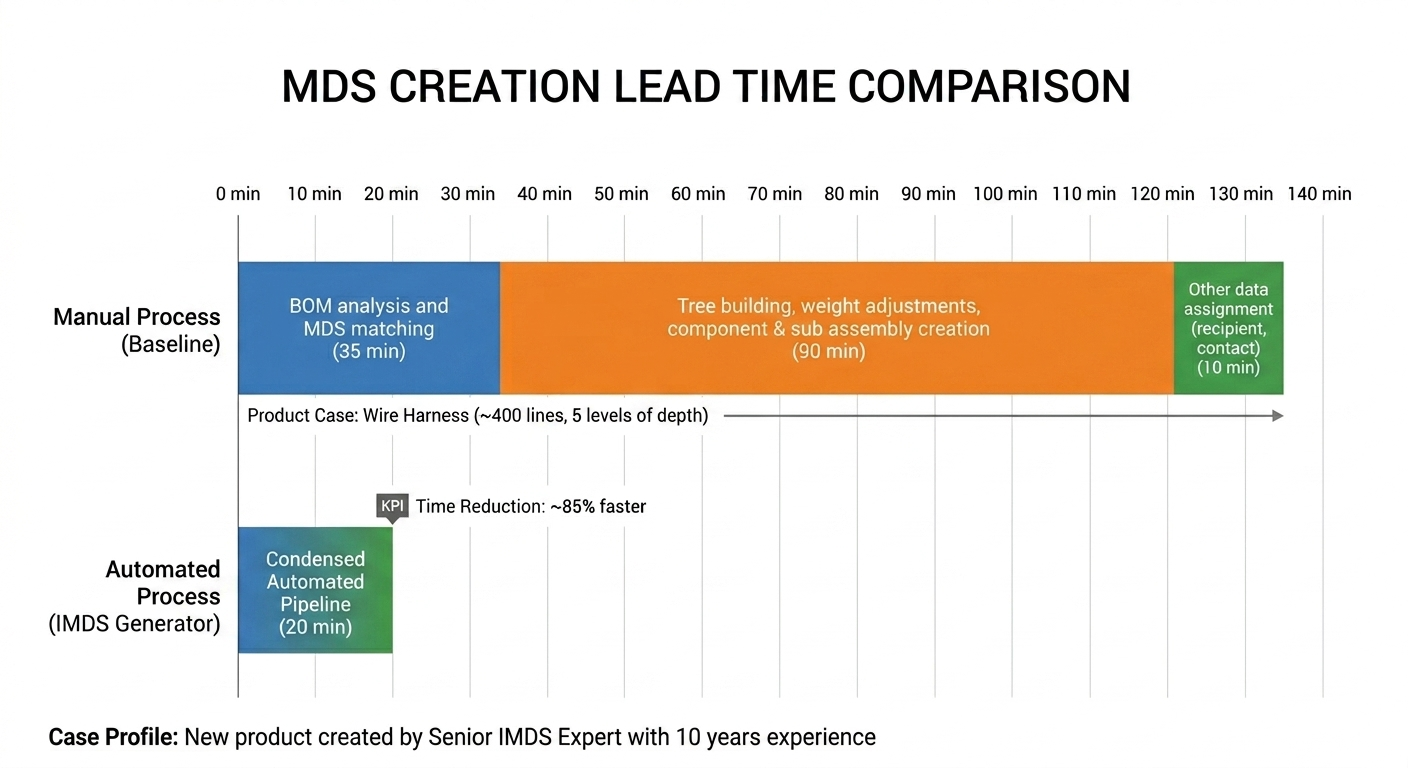
For many organizations, however, the main value is not just time savings or easier MDS creation. My solutions allow specialists to focus on the key challenges of material compliance, eco-design, and the circular economy, including recycling and Life Cycle Assessment (LCA). This results in a stable and transparent process that builds trust in the market and helps strengthen business relationships.
Summary
The modern automotive ecosystem is subject to increasingly high demands regarding the quality and timeliness of material data. Current and upcoming regulations, a more stringent approach to materials used, and the need for carbon footprint and ESG reporting mean that manual creation and maintenance of MDS structures is becoming a thing of the past. What once was merely a formality required to close the PPAP process is now becoming a cornerstone of the environmental and business strategy of every organization.
IMDS Generator and the Request Center platform were created in response to real challenges I have observed over the years. My goal was not to develop another expensive and complex system, but to provide a fast, cost-effective, and user-friendly tool.
Together with IMDS Plus, these solutions make up a complete, automated environment. They help relieve specialists from repetitive, manual work, transforming material data management into a precise process that is robust to market changes and supports competitive advantage. All of this is achieved with minimal implementation and maintenance effort.
Cost-efficient automation of the IMDS process delivers significant savings and improves compliance and audit transparency. Based on my own experience, it also provides peace of mind for everyone involved in the process. I often hear that work which used to be stressful and problematic turns out to be easier, more transparent and just predictable.
When engineers no longer have to spend their time firefighting and working under pressure, they can focus on tasks that actually help move the business forward. Instead of struggling with the system every day, working with IMDS becomes a rewarding and predictable part of the job, bringing satisfaction rather than frustration.
See IMDS Generator in action & register for a free demo
If you would like to see how IMDS Generator, Request Center, and IMDS Plus can improve the preparation and maintenance of IMDS data in your organization, I invite you to join a free webinar or schedule an individual demo.
During the session, I will demonstrate how to go from BOM data to a complete MDS structure in just a few minutes, how to efficiently manage material data updates, and how to implement best practices that help standardize the entire process and speed up the collection of required information.
Register for our free webinar and discover how to automate IMDS processes within your organization.